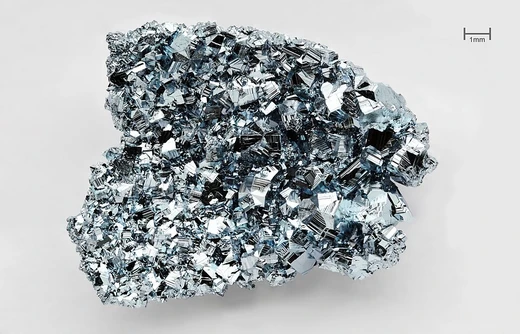
Silicon
Elemental silicon is the basis of the Silicon Age.

Silicon is a chemical element with symbol Si and atomic number 14. It is a hard, brittle crystalline solid with a blue-grey metallic lustre, a tetravalent non-metal (sometimes considered a metalloid) and semiconductor. It is a member of group 14 in the periodic table, with carbon above it and germanium, tin, lead, and flerovium below it. Silicon is significant as the dominant material in semiconductor electronics, essential to modern technology such as transistors, solar cells, and integrated circuits, and is also crucial for several physiological and metabolic processes in plants.
- symbol
- Si
- atomic_number
- 14
- group
- 14
- abundance_in_earth_crust
- about 28% by mass (second most abundant)
Lore & Background
Owing to the abundance of silicon in the Earth's crust, natural silicon-based materials have been used for thousands of years. Silicon rock crystals were familiar to ancient civilizations such as the predynastic Egyptians and ancient Chinese. Natural silicate compounds were used in mortar for early human dwellings. Silicon was given its present name in 1817 by Thomas Thomson.
Reader's Guide
Silicon's significance stems from its role as the primary semiconductor material in modern electronics, dominating applications due to its low cost, excellent electronic properties, and adaptable physical characteristics. The late 20th century to early 21st century has been described as the Silicon Age (also known as the Digital Age or Information Age) because of the large impact elemental silicon has on the modern world economy. Although less than 15% of highly purified elemental silicon is used in semiconductor electronics, that portion is essential to transistors and integrated circuit chips used in most modern technology such as smartphones and other computers. Beyond electronics, silicon compounds are widely used in construction (concrete, mortar, glass), ceramics, abrasives, and synthetic polymers called silicones. Silicon is also an essential element in biology, with sea sponges and microorganisms like diatoms secreting silica skeletal structures, and silica deposited in many plant tissues.
Did You Know?
- Silicon is the second most abundant element in the Earth's crust, at about 28% by mass, after oxygen.
- More than 90% of the Earth's crust is composed of silicate minerals.
Frequently Asked Questions
Who is Silicon?
Silicon (Si, atomic number 14) is a hard, brittle crystalline solid with a blue-grey metallic shine. It is a tetravalent non-metal—sometimes classed as a metalloid—occupying group 14 of the periodic table directly beneath carbon.
What are Silicon's powers or role?
Silicon is the foundational material of semiconductor electronics, underpinning transistors, solar cells, and integrated circuits. Its unique ability to conduct electricity under controlled conditions is what defines the era often called the Silicon Age.
How does Silicon's story end?
As a stable, naturally occurring element, Silicon has no narrative arc that concludes; its ongoing significance is tied to the continued evolution of semiconductor technology. It also remains essential to several physiological and metabolic processes in living plants.
Why is Silicon so important?
Making up roughly 28% of the Earth's crust by mass, Silicon is the second most abundant element, which makes it both ubiquitous and indispensable. Its dual role in modern electronics and plant biology gives it a level of cross-disciplinary importance few other elements match.
Where does Silicon sit among its group 14 family?
Silicon is the second member of group 14, positioned directly below carbon with germanium, tin, lead, and flerovium stacked beneath it. This vertical arrangement reflects a shared tetravalent bonding pattern that runs through the entire column.
More in Chemical Elements & Metals 1-20
Spotted an error? Know more?
This is a living reference — every entry is fact-audited, and reader corrections feed straight into our audit queue. Suggest an edit · See this site's audit record