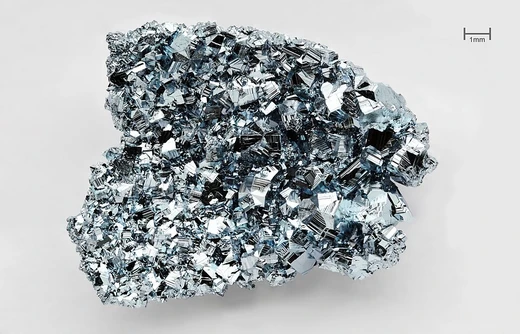
Plutonium
A radioactive actinide metal used in nuclear weapons and reactors.

Plutonium is a chemical element with symbol Pu and atomic number 94. It is a silvery-gray actinide metal that tarnishes when exposed to air, forms a dull coating when oxidized, and is radioactive. Although not the element with the highest atomic number known to occur in nature (elements heavier than plutonium, such as californium, are synthetic and not found in detectable natural quantities), plutonium is one of the most significant transuranic elements, with isotopes used in nuclear weapons, nuclear reactors, and spacecraft power sources.
- symbol
- Pu
- atomic_number
- 94
- discovery_location
- University of California, Berkeley
- known_for
- fissile material for nuclear weapons and reactors; heat source in radioisotope thermoelectric generators
Lore & Background
Since uranium had been named after the planet Uranus and neptunium after Neptune, element 94 was named after Pluto, which at the time was also considered a planet. Producing plutonium in useful quantities for the first time was a major part of the Manhattan Project during World War II that developed the first atomic bombs. Human radiation experiments studying plutonium were conducted without informed consent, and several criticality accidents, some lethal, occurred after the war. Plutonium normally exhibits six allotropes at ambient pressure and oxidation states from +3 to +7. It reacts with carbon, halogens, nitrogen, silicon, and hydrogen. When exposed to moist air, it forms oxides and hydrides that can expand the sample up to 70% in volume, which in turn flake off as a powder that is pyrophoric. It is radioactive and can accumulate in bones, making handling dangerous.
Reader's Guide
This led to its use in the first atomic bombs during World War II, including the Trinity test and the Nagasaki bombing. Disposal of plutonium waste from nuclear power plants and dismantled nuclear weapons built during the Cold War is a nuclear-proliferation and environmental concern. Other sources of plutonium in the environment are fallout from many above-ground nuclear tests, now banned. The element's complex allotropes and physical properties, such as its low melting point and high boiling point, make it challenging to handle and machine.
Did You Know?
- Plutonium was named after Pluto, which at the time was considered a planet.
- When exposed to moist air, plutonium forms oxides and hydrides that can expand the sample up to 70% in volume, flaking off as a pyrophoric powder.
- The plutonium cores used in the Trinity nuclear test (the 'Gadget') and the bombing of Nagasaki (the 'Fat Man' bomb) were both based on the same implosion design.
Frequently Asked Questions
Who is Plutonium?
Plutonium (symbol Pu, atomic number 94) is a silvery-gray radioactive actinide metal that grows a dull oxide skin once it meets air. It sits just past uranium on the periodic table and is one of the most consequential transuranic elements ever identified.
What are Plutonium's powers and role?
Its isotope Pu-239 is a fissile material at the heart of nuclear weapons and certain reactor cores. It also serves as the heat source inside radioisotope thermoelectric generators that keep deep-space probes running for decades.
How does Plutonium's story end?
Because every plutonium isotope is radioactive, the element is on a slow, irreversible path to decay into lighter elements. The widely used Pu-239 has a half-life of roughly 24,000 years, so its 'ending' unfolds over geological timescales rather than in a single dramatic event.
Why is Plutonium important?
It is one of the very few synthetic elements with large-scale practical uses, spanning military, civilian energy, and space-exploration applications. That dual-use character makes it a constant focus of nuclear non-proliferation policy around the world.
Where and when was Plutonium discovered?
It was first synthesized and identified in 1940 at the University of California, Berkeley, by a team led by Glenn Seaborg and Arthur Wahl. The work was part of wartime research into elements heavier than uranium.
More in Chemical Elements & Metals 1-20
Spotted an error? Know more?
This is a living reference — every entry is fact-audited, and reader corrections feed straight into our audit queue. Suggest an edit · See this site's audit record