Rhodium
Rare noble metal used in catalytic converters and jewelry plating.

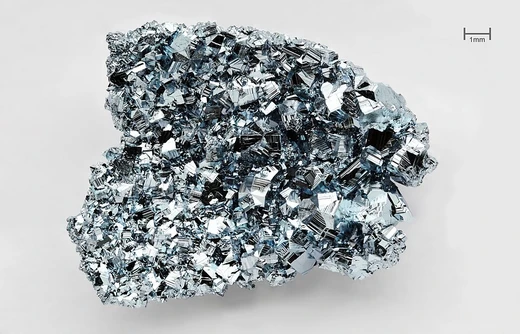
Rhodium is a chemical element with symbol Rh and atomic number 45. It is a very rare, dark silvery-white, hard, corrosion-resistant transition metal, a noble metal, and a member of the platinum group.
- symbol
- Rh
- atomic_number
- 45
- discovered_by
- William Hyde Wollaston
- group
- 9 (cobalt group)
- natural_isotope
- 103Rh
- major_use
- Catalyst in three-way catalytic converters (80% of production)
Lore & Background
For decades, rhodium had only minor applications, such as in thermocouples measuring temperatures up to 1800 °C. The first major application was electroplating for decorative uses and corrosion-resistant coatings. Rhodium is found in platinum or nickel ores with other platinum group metals, and its principal production is in South Africa (75%), with lesser amounts from Russia and Zimbabwe.
Reader's Guide
Rhodium's significance lies in its extreme rarity and unique chemical properties. As one of the rarest elements in the Earth's crust (less than one part per billion), it is highly valued for its corrosion resistance and catalytic activity. Rhodium is also used to plate white gold and sterling silver to improve appearance and resist tarnishing. In nuclear reactors, rhodium detectors measure neutron flux. Despite its high cost, rhodium-based catalysts have displaced cheaper cobalt-based ones in hydroformylation of alkenes. Used nuclear fuel is a potential source, but extraction is complex and expensive.
Did You Know?
- Naturally occurring rhodium has only one isotope, 103Rh.
- Rhodium is completely insoluble in nitric acid and dissolves only slightly in aqua regia.
Frequently Asked Questions
Who is Rhodium?
Rhodium is a rare, hard, silvery-white transition metal with atomic number 45, belonging to the platinum group of noble metals. It sits in group 9 of the periodic table alongside cobalt and iridium.
What are Rhodium's powers or role?
Rhodium's standout ability is its exceptional corrosion resistance and catalytic activity, making it the star ingredient in three-way catalytic converters that scrub toxic gases from car exhaust. It also lends a brilliant, tarnish-free shine to high-end jewelry plating.
How does Rhodium's story end?
Because Rhodium is a naturally occurring element rather than a fictional character, it has no narrative arc, but its only stable isotope is 103Rh, so every atom you encounter is that single variant. Its extreme scarcity—far rarer than gold—limits how widely it can appear in everyday applications.
Why is Rhodium important?
Roughly 80% of all rhodium produced goes into catalytic converters, where it helps convert harmful pollutants into less dangerous gases, making it quietly critical to automotive emissions control. Its noble-metal chemistry and rarity also make it a prized plating material in luxury jewelry.
Who discovered Rhodium?
The English chemist William Hyde Wollaston identified rhodium in 1803 while studying platinum ore. The name derives from the Greek word 'rhodon,' meaning rose, a nod to the pink-colored salts he observed during his experiments.
More in Chemical Elements & Metals 1-20
Spotted an error? Know more?
This is a living reference — every entry is fact-audited, and reader corrections feed straight into our audit queue. Suggest an edit · See this site's audit record