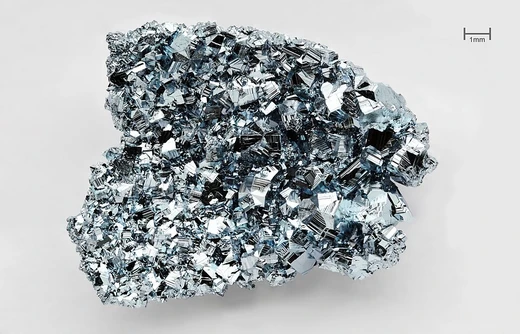
Polonium
Highly radioactive element discovered by the Curies.

Polonium is a chemical element with symbol Po and atomic number 84. It was the first element to be identified solely by its strong radioactivity, extracted from the uranium ore pitchblende, and named after Marie Curie's homeland of Poland.
- symbol
- Po
- atomic_number
- 84
- discovered_by
- Marie Skłodowska-Curie and Pierre Curie
- named_after
- Poland (Latin: Polonia)
- notable_for
- First element discovered by radioactivity; used in space probes, antistatic devices, and poison
Lore & Background
After removing uranium and thorium, the remaining pitchblende was more radioactive than the two combined, spurring the Curies to search for additional radioactive elements. During World War II, polonium was produced as part of the Manhattan Project's Dayton Project in the United States. Polonium and beryllium were key ingredients of the 'Urchin' initiator at the center of the bomb's spherical pit, which initiated the nuclear chain reaction at prompt-criticality. Much of the basic physics of polonium was classified until after the war, and the use of a polonium-beryllium initiator in implosion-type nuclear weapons remained classified until the 1960s. Polonium has few applications, related to its radioactivity: heaters in space probes, antistatic devices, sources of neutrons and alpha particles, and poison (e.g., poisoning of Alexander Litvinenko). It is extremely dangerous to humans.
Reader's Guide
Polonium is significant as the first element discovered solely through its radioactivity, a milestone in nuclear chemistry. Polonium's naming after Marie Curie's native Poland, then partitioned and not independent, marked the first element named to highlight a political controversy. Applications include space probe heaters, antistatic devices, and neutron sources, as well as its use as a poison. During World War II, polonium-beryllium initiators were critical in early U.S. nuclear weapons. The element's chemistry is studied mostly on a trace scale due to its radioactivity, and it has no stable isotopes.
Did You Know?
- Polonium was the first element discovered solely by its strong radioactivity.
- Polonium was named after Marie Curie's homeland of Poland, which at the time was partitioned between three countries.
Discovery and a Name Born of Exile
This made polonium the first element ever identified by its radiation signature alone. The couple assigned it atomic number 84 and the symbol Po. Marie chose the name as a tribute to her native Poland, a country that at the time did not exist as a sovereign state and was instead divided among three neighboring empires. The naming was thus an act of quiet political defiance woven into the language of chemistry. Because every isotope of polonium is radioactive and decays relatively quickly, the element never accumulated in the Earth's crust in any meaningful quantity.
A Metal That Glows, Heats, and Vanishes
When a few curies are concentrated together, the ionization of surrounding air produces a faint blue luminescence. In solid form, polonium presents two metallic allotropes. One leading explanation is that alpha decay spalls tiny atomic clusters off the surface, carrying them into the gas phase.
A Chemistry Written and Erased by Its Own Radiation
Polonium's chemical behavior echoes that of tellurium, its fellow chalcogen, while its metallic character borrows from neighboring bismuth, lead, and thallium. It dissolves readily in dilute acids but shows only slight solubility in alkaline solutions. In solution, polonium initially appears pink as Po²⁺ ions, but the alpha radiation it continuously emits ionizes the solvent and rapidly oxidizes those ions to Po⁴⁺, shifting the color to yellow. The same radiation causes visible bubbling, generates heat, and makes glassware glow, and the solutions are so volatile that they evaporate within days unless tightly sealed. At a pH near one, polonium ions are easily hydrolyzed and form complexes with oxalic, citric, and tartaric acids. Because the element's intense self-irradiation destroys chemical bonds, virtually all of its chemistry has been studied only at the trace scale. More than fifty synthetic compounds are catalogued, including polonides with diverse crystal structures (antifluorite, rock-salt, wurtzite, nickel-arsenide), three oxides, several halides, and a small family of organopolonium species such as dialkyl and diaryl polonides. Polonium hydride is a volatile, thermally unstable liquid at room temperature.
Instruments of Science and Instruments of Death
Because of its extraordinary specific activity, polonium has found a narrow set of practical uses, all tied directly to its radioactivity. Milligram-scale quantities, typically produced by bombarding bismuth with neutrons in a reactor, serve as compact radioisotope heaters for space probes, as antistatic coatings, and as sources of alpha particles or neutrons in specialized instruments. Yet the same property that makes it useful makes it lethally dangerous. The element's airborne volatility compounds the hazard; even a small heated sample can release radioactive Po₂ vapor into a room. In the laboratory, handling is restricted to trace amounts because the self-heating and bond-breaking radiation make bulk manipulation impractical and extraordinarily hazardous. Polonium thus occupies a unique niche: a scientific curiosity that is simultaneously a precision tool and a weapon of devastating lethality.
Frequently Asked Questions
Who is Polonium?
Polonium (Po, atomic number 84) is a highly radioactive metalloid first isolated in 1898 by Marie and Pierre Curie from pitchblende ore. It was named in honor of Poland, Marie Curie's birthplace.
What are Polonium's powers or role?
Its defining trait is intense radioactivity, which made it the first element ever identified purely through its emissions rather than chemical behavior. In practical applications, trace amounts serve in space-probe power sources, antistatic coatings, and—infamously—as a lethal poison.
How does Polonium's story end?
Polonium is inherently unstable; its most common isotope, Po-210, has a half-life of roughly 138 days before decaying into stable lead. As a result, no naturally occurring Polonium persists in meaningful quantities over geological timescales.
Why is Polonium important in the broader element roster?
It holds the milestone of being the first chemical element discovered through the study of radioactivity, a breakthrough that helped launch the field of nuclear physics. Its identification also cemented the Curies' legacy and contributed to Marie's Nobel Prize in Chemistry.
What is Polonium's biggest weakness?
Polonium is extraordinarily toxic—Po-210 is on the order of 250,000 times more poisonous than cyanide—and it is vanishingly rare in nature. Combined with its short half-life, this makes it nearly impossible to encounter or handle in any practical quantity.
More in Chemical Elements & Metals 1-20
Spotted an error? Know more?
This is a living reference — every entry is fact-audited, and reader corrections feed straight into our audit queue. Suggest an edit · See this site's audit record