Protactinium
Rare radioactive element used in ocean science and nuclear research.

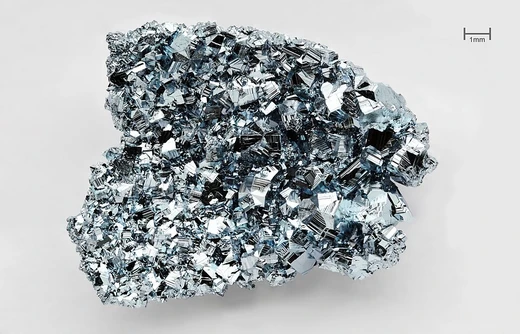
Protactinium is a chemical element with symbol Pa and atomic number 91. It is a dense, radioactive, silvery-gray actinide metal that readily reacts with oxygen, water vapor, and inorganic acids. It is one of the rarest and most expensive naturally occurring elements, found in the Earth's crust at concentrations of a few parts per trillion, though it can reach up to a few parts per million in some uraninite ore deposits. Because of its scarcity, high radioactivity, and high toxicity, protactinium currently has no uses outside scientific research, and it is mostly extracted from spent nuclear fuel.
- symbol
- Pa
- atomic_number
- 91
Reader's Guide
Protactinium is significant as one of the last gaps in the early periodic table to be filled, and its discovery brought fame to the involved scientists. In nuclear reactors, protactinium isotopes 231Pa and 233Pa are undesirable intermediates, adding complexity to reactor design, particularly in thorium-based reactors where 233Pa must be removed.
Did You Know?
- Protactinium was first named 'brevium' because of the short half-life of the isotope 234mPa.
- Protactinium is the only highly radioactive mononuclidic element that is not also monoisotopic.
The Long Search and the Naming Controversy
For decades, chemists hunted for this hypothetical 'eka-tantalum,' assuming it would mimic tantalum's chemistry — a mistaken assumption that rendered the true element nearly invisible to them.
Chemical Character and Practical Limitations
Protactinium is a dense, silvery-gray actinide metal that is inherently radioactive and chemically reactive. It readily attacks oxygen, water vapor, and inorganic acids, making its handling a constant challenge for researchers. In its compounds, protactinium most commonly adopts the +5 oxidation state, though it can also stabilize in the +4, +3, and even +2 states, giving it a versatile but complex chemistry. Despite this richness, the element has no practical applications outside the laboratory. Its extreme scarcity in the Earth's crust — typically only a few parts per trillion, rising to a few parts per million in certain uraninite ore deposits — combined with intense radioactivity and high toxicity, renders it economically and safely impractical for industrial use. For the limited scientific research that does employ it, protactinium is extracted primarily from spent nuclear fuel.
From Milligrams to Kilograms: Production and Scientific Legacy
Early quantities of protactinium were vanishingly small. For years this batch was the world's only significant supply, distributed to laboratories for research. This uniformity, together with the element's role in sediment dating and reactor chemistry, has cemented protactinium's place as a vital, if obscure, tool in geochemistry and nuclear science.
Frequently Asked Questions
Who is Protactinium?
Protactinium is a dense, silvery-gray actinide metal carrying the symbol Pa and atomic number 91. It is a highly radioactive element that reacts aggressively with oxygen, water vapor, and inorganic acids, placing it among the more reactive members of the actinide family.
What are Protactinium's powers or abilities?
Its chemical reactivity is its standout trait: it readily bonds with oxygen, water, and acids, making it difficult to keep in a stable metallic form. Combined with its intense radioactivity and high toxicity, these properties make it a fascinating but dangerous subject for nuclear and ocean-science research.
Where does Protactinium appear in the real world?
It lingers in Earth's crust at only a few parts per trillion, though some uraninite ore deposits can concentrate it to a few parts per million. In practice, most of the material available to researchers is pulled out as a byproduct during spent nuclear fuel reprocessing.
Why is Protactinium so rare and expensive?
Its natural abundance is vanishingly low, and the combination of strong radioactivity with high toxicity makes every step of extraction and purification extremely costly. Those hurdles keep it firmly locked into the research-only tier with zero commercial applications.
What is Protactinium's endgame or role in the bigger picture?
As of today, Protactinium has no practical uses outside scientific research, where it shows up in ocean-science tracers and nuclear studies. Its scarcity, radioactivity, and toxicity effectively relegate it to a supporting-lab role rather than any industrial main-character part.
More in Chemical Elements & Metals 1-20
Spotted an error? Know more?
This is a living reference — every entry is fact-audited, and reader corrections feed straight into our audit queue. Suggest an edit · See this site's audit record