Palladium
Rare platinum-group metal used in catalytic converters and jewelry.

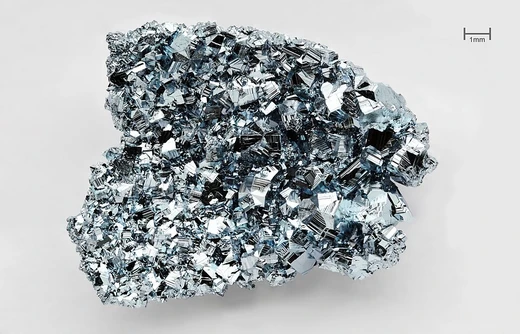
Palladium is a chemical element with the symbol Pd and atomic number 46. Palladium is one of the platinum group metals, noted for having the lowest melting point and lowest density among them. Its primary use is in catalytic converters, which convert harmful automobile exhaust gases into nontoxic substances, and it also finds applications in electronics, dentistry, medicine, hydrogen purification, and jewelry.
- symbol
- Pd
- atomic_number
- 46
- discoverer
- William Hyde Wollaston
- group
- Platinum group metals
- key_property
- Lowest melting point and least dense of platinum group metals
Lore & Background
Palladium belongs to group 10 in the periodic table, with a unique electron configuration where the 5s orbital is empty, making it the heaviest element with only one incomplete electron shell. It is soft and ductile when annealed, strengthens with cold-working, and does not tarnish in air, though it may develop a slight brownish coloration over time. Palladium dissolves slowly in concentrated nitric acid, hot concentrated sulfuric acid, and aqua regia, and when heated to 800 °C forms a layer of palladium(II) oxide.
Reader's Guide
Palladium's significance stems from its critical role in catalytic converters, which process more than half of the global supply to reduce automobile emissions. Its limited ore deposits—primarily in South Africa's Bushveld Igneous Complex, Montana's Stillwater Complex, Canada's Sudbury Basin, and Russia's Norilsk Complex—along with recycling from scrapped converters, make it a valuable precious metal traded as coins and bars. In chemistry, palladium compounds, especially in the 0 and +2 oxidation states, are essential catalysts for coupling reactions such as the Heck, Suzuki, and Sonogashira reactions, recognized by the 2010 Nobel Prize in Chemistry. Its isotopes include stable forms and radioactive 107Pd, a long-lived fission product with a half-life of 6.5 million years, found in nature and produced in nuclear reactors. Despite its utility, palladium's rarity and concentrated production in Russia and South Africa create significant investment interest and supply chain considerations.
Did You Know?
- Palladium was named after the asteroid Pallas, which was named after the Greek goddess Athena.
- Palladium has the lowest melting point and is the least dense of the platinum group metals.
- More than half of palladium supply is used in catalytic converters to reduce automobile exhaust pollutants.
- Palladium can be found as a free metal alloyed with gold in placer deposits, but most production comes from nickel-copper deposits.
Discovery and Mythological Roots
Wollaston chose its name in honor of the asteroid Pallas—formally designated 2 Pallas—which had itself received its title from an epithet of the Greek goddess Athena, one she acquired after slaying the figure Pallas. This mythological thread gives the element a lineage stretching back to ancient storytelling. Palladium sits within the platinum group metals, alongside platinum, rhodium, ruthenium, iridium, and osmium. While all six share broadly similar chemical behavior, palladium distinguishes itself as the least dense member of the family and the one with the lowest melting point. Its scarcity in the Earth's crust, combined with its distinctive appearance and properties, made Wollaston's identification a notable addition to the chemical landscape of the early nineteenth century.
Industrial Workhorse and Precious Metal
More than half of the world's palladium supply—and a comparable share of its congener platinum—finds its way into catalytic converters, the devices fitted to automobiles that transform up to ninety percent of harmful exhaust gases, including hydrocarbons, carbon monoxide, and nitrogen dioxide, into harmless nitrogen, carbon dioxide, and water vapor. Beyond automotive emissions control, palladium serves in electronics, dentistry, medicine, hydrogen purification, electrochemical sensors, electrosynthesis, groundwater treatment, and fine jewelry. Because natural ore deposits are scarce, recycling from scrapped catalytic converters represents a meaningful secondary source of the metal. The combination of broad industrial demand and limited geological supply has made palladium a frequent target of investment interest, and it is commonly traded as a precious metal in the form of coins and bars.
Electron Architecture and Physical Behavior
Palladium occupies group 10 of the periodic table, yet its outermost electron arrangement defies the simple Madelung-rule prediction. Rather than filling the 5s orbital first, electrons populate the 4d subshell to achieve a completely filled 4d¹⁰ configuration, a choice that is more energetically favorable. This 5s⁰ arrangement is unique across period 5 and makes palladium the heaviest element possessing only a single incomplete electron shell, with every shell above it entirely empty. Physically, the metal presents as a soft, silver-white substance closely resembling platinum. When annealed it is ductile and malleable, but cold-working dramatically increases its strength and hardness. It resists tarnishing in ordinary air because it does not react with oxygen at standard temperature, though heating to 800 °C produces a layer of palladium(II) oxide. In a remarkable low-temperature phenomenon, palladium films containing defects introduced by alpha-particle bombardment exhibit superconductivity at a critical temperature of 3.2 K.
Catalytic Chemistry and Nobel-Recognized Reactions
Palladium compounds exist predominantly in the zero and +2 oxidation states, with their chemistry bearing a closer resemblance to platinum than to any other element. Palladium(II) chloride, formed by direct reaction of the metal with chlorine, serves as the principal gateway to other palladium species. It yields heterogeneous catalysts such as palladium on barium sulfate or on carbon, and in the presence of nitric and acetic acids it produces palladium(II) acetate, a versatile reagent in its own right. In the zerovalent state, palladium forms complexes like tetrakis(triphenylphosphine)palladium(0) and tris(dibenzylideneacetone)dipalladium(0). The catalytic power of both oxidation states in coupling reactions—Heck, Suzuki, Sonogashira, Stille, and Kumada—earned Richard F. Heck, Ei-ichi Negishi, and Akira Suzuki the 2010 Nobel Prize in Chemistry. These transformations are now widely practiced in the synthesis of fine chemicals, cementing palladium's role as one of the most consequential catalysts in modern organic and industrial chemistry.
Frequently Asked Questions
What is Palladium and where does it sit on the periodic table?
Palladium (Pd) is element number 46, a rare platinum-group metal that occupies the d-block of the periodic table. It is one of the lighter and softer members of that elite family of transition metals.
What makes Palladium stand out among the other platinum group metals?
It holds two superlatives within its group: the lowest melting point and the lowest density of all platinum-group metals. This makes it comparatively easier to work with and machine than its heavier cousins.
What is Palladium's most iconic real-world role?
Its headline act is serving as the active catalyst inside automotive catalytic converters, where it facilitates the breakdown of toxic exhaust compounds like carbon monoxide and nitrogen oxides into harmless gases. Without it, modern tailpipe emissions control would be far less effective.
Who discovered Palladium and how did it get its name?
English chemist William Hyde Wollaston identified the element in 1803 while processing platinum ore. He named it after the asteroid Pallas, which had only been discovered a few years earlier, tying the new metal to the growing world of celestial nomenclature.
Why do fans and industry both consider Palladium so important?
Beyond catalysis, it is prized in electronics contacts, dental alloys, medical implants, hydrogen purification membranes, and fine jewelry because of its corrosion resistance and attractive white luster. Its scarcity and multi-sector demand keep it at the top of the precious-metals conversation.
More in Chemical Elements & Metals 1-20
Spotted an error? Know more?
This is a living reference — every entry is fact-audited, and reader corrections feed straight into our audit queue. Suggest an edit · See this site's audit record