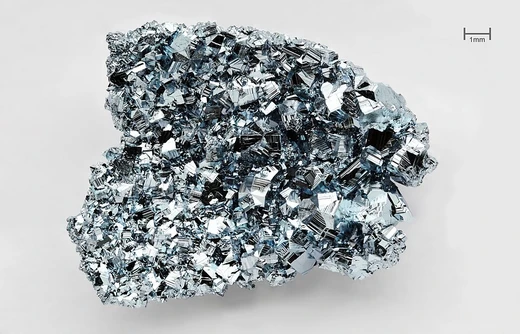
Praseodymium
A rare-earth element known for its green salts and optical filtering.

Praseodymium is a chemical element with symbol Pr and atomic number 59. It is the third member of the lanthanide series and is considered one of the rare-earth metals. It is a soft, silvery, malleable and ductile metal valued for its magnetic, electrical, chemical, and optical properties. It is too reactive to be found in native form, and pure praseodymium metal slowly develops a green oxide coating when exposed to air. Praseodymium always occurs naturally together with the other rare-earth metals, making up 9.1 parts per million of the Earth's crust.
- symbol
- Pr
- atomic_number
- 59
- series
- Lanthanide
- category
- Rare-earth metal
- abundance
- 9.1 ppm in Earth's crust
- discoverer
- Carl Auer von Welsbach
Lore & Background
The name praseodymium comes from the Ancient Greek πράσινος (prasinos), meaning 'leek-green', and δίδυμος (didymos) 'twin'. Praseodymium most readily forms the +3 oxidation state, which is the only stable state in aqueous solution, although the +4 oxidation state is known in some solid compounds and, uniquely among the lanthanides, the +5 oxidation state is attainable at low temperatures. Aqueous praseodymium ions are yellowish-green, and similarly, praseodymium results in various shades of yellow-green when incorporated into glasses. Many of praseodymium's industrial uses involve its ability to filter yellow light from light sources. Praseodymium has only one stable and naturally occurring isotope, 141Pr, making it a mononuclidic and monoisotopic element. Thirty-eight other radioisotopes have been synthesized, all with half-lives under a day except 143Pr with a half-life of 13.57 days.
Reader's Guide
Praseodymium is significant as a rare-earth element with unique optical and magnetic properties. Its ability to filter yellow light makes it valuable in industrial applications, such as in glasses and light sources. As the third member of the lanthanide series, it exemplifies the chemical behavior of early lanthanides, including a tendency to form multiple oxidation states, including the rare +5 state observed under low-temperature conditions. Its natural occurrence exclusively with other rare-earth metals and its single stable isotope contribute to its scientific interest. Praseodymium's paramagnetism at all temperatures above 1 K and its corrosion behavior in air further distinguish it among the lanthanides. Its legacy lies in both fundamental chemistry and practical uses, particularly in filtering and coloring materials.
Did You Know?
- Praseodymium is the sixth-most abundant rare-earth element and fourth-most abundant lanthanide in the Earth's crust.
- The name praseodymium comes from Ancient Greek words meaning 'leek-green' and 'twin'.
- Praseodymium has only one stable isotope, 141Pr, which has 82 neutrons, a magic number conferring additional stability.
The Long Separation from Didymium
For nearly forty-four years, the element we now call praseodymium existed only as an inseparable partner within a mixed oxide that chemists called didymium. But didymium proved to be a stubborn blend of two distinct elements that refused to separate by ordinary means. He christened the leek-green one praseodymium, drawing on the Ancient Greek words prasinos for 'leek-green' and didymos for 'twin,' a nod to its long entanglement with its sibling neodymium. The name itself thus encodes both the element's characteristic hue and the decades of chemical effort required to free it from its twin.
Crystal Architecture and Magnetic Behaviour
Praseodymium sits as the third entry in the lanthanide row of the periodic table, flanked by cerium on one side and neodymium on the other, with the actinide protactinium positioned directly below. Its fifty-nine electrons arrange themselves in the configuration [Xe]4f³6s², and because the 4f orbitals penetrate deeply toward the nucleus through the inert xenon core, those inner electrons remain too tightly held to participate in ordinary bonding. The metal itself is ductile, with a hardness roughly matching that of silver, and at room temperature it adopts a double hexagonal close-packed crystal lattice known as the alpha phase. One of its most distinctive physical traits is its magnetic response: unlike several other rare-earth metals that develop antiferromagnetic or ferromagnetic ordering when cooled, praseodymium remains paramagnetic at every temperature above one kelvin, never settling into a cooperative spin arrangement.
Oxidation States and Aqueous Chemistry
In solution, praseodymium almost exclusively adopts the +3 oxidation state, producing yellowish-green Pr³⁺ ions that exist as nine-coordinate aqua complexes, [Pr(H₂O)₉]³⁺. This is the only stable state in water, and it is the form encountered when the metal dissolves in dilute sulfuric acid or reacts with hot water to yield praseodymium(III) hydroxide and hydrogen gas. Yet Pr⁴⁺ is far too aggressive in aqueous media: its reduction potential of +3.2 V means it will oxidise water and collapse back to Pr³⁺. The 0, +1, and +2 states are exceedingly rare, and the metal's reactions with all four stable halogens consistently yield green trihalides.
Abundance, Reactivity, and Practical Identity
Although classified as a rare-earth metal, praseodymium is actually the sixth most abundant member of that family and the fourth most common lanthanide, accounting for 9.1 parts per million of the Earth's crust—a concentration comparable to that of boron. It never occurs in native metallic form; its reactivity is too high, and it is always found locked in mineral mixtures alongside its fellow rare-earth elements. Exposed to air, a piece of praseodymium metal slowly develops a spalling green oxide coating, and a centimetre-sized sample will corrode entirely in roughly a year. At 150 °C it ignites readily, forming the nonstoichiometric oxide Pr₆O₁₁. Despite this fragility, the element is prized in industry for its magnetic, electrical, chemical, and optical properties, and many of its applications exploit its capacity to filter yellow light from light sources. Its soft, silvery, malleable character and these functional traits together define its practical identity as a material.
Frequently Asked Questions
Who is Praseodymium?
Praseodymium (symbol Pr, atomic number 59) is a soft, silvery rare-earth metal and the third member of the lanthanide series. It was identified by Carl Auer von Welsbach, who split the old 'didymium' mixture into its two distinct components.
What are Praseodymium's powers/role?
Praseodymium is prized for its magnetic, electrical, chemical, and optical properties, especially its vivid green salts and its ability to serve as an optical filter. The metal itself is malleable and ductile, making it workable in specialized alloys.
How does Praseodymium's story end?
Because it is far too reactive to exist in native form, a piece of pure praseodymium metal will slowly develop a green oxide coating when left in air. In nature it never appears on its own; it is always locked in with the other rare-earth metals in the same ore deposits.
Why is Praseodymium important?
Its unique blend of magnetic and optical traits makes it indispensable in specialty alloys, colored glass, and laser media. It accounts for roughly 9.1 parts per million of the Earth's crust, always riding alongside its lanthanide neighbors rather than in isolation.
Who discovered Praseodymium and where is it found?
Carl Auer von Welsbach is credited with isolating praseodymium in 1885 by separating it out of the didymium mineral. In the ground it is never a solo find; it co-occurs with the rest of the rare-earth family in the same mineral deposits.
More in Chemical Elements & Metals 1-20
Spotted an error? Know more?
This is a living reference — every entry is fact-audited, and reader corrections feed straight into our audit queue. Suggest an edit · See this site's audit record