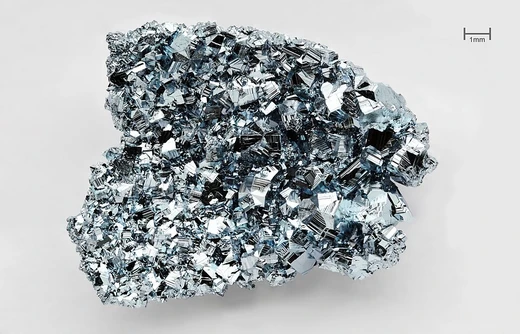
Potassium
Soft alkali metal essential to life and widely used in fertilizers.

Potassium is a chemical element with symbol K (from Neo-Latin kalium) and atomic number 19. It is a silvery white metal, soft enough to cut with a knife, and reacts rapidly with atmospheric oxygen. First isolated from potash (the ashes of plants), potassium is one of the alkali metals and occurs in nature only in ionic salts. It is vital for all living cells, particularly for nerve transmission, and is a key component of agricultural fertilizers.
- symbol
- K
- atomic_number
- 19
- discovered_by
- Humphry Davy
- method_of_isolation
- electrolysis of molten caustic potash (KOH)
- group
- alkali metals
- key_property
- soft, silvery white metal; reacts vigorously with water
Lore & Background
Later that year, Davy similarly extracted sodium, demonstrating the two elements are distinct. The name 'potassium' derives from potash, the ashes of plants; the symbol K comes from 'kali', rooted in the Arabic word for plant ashes. German chemist Martin Klaproth had earlier recognized potash as containing a new element, proposing the name 'kali'.
Reader's Guide
Potassium's significance spans biology, industry, and chemistry. As an alkali metal with a single valence electron, it readily forms positive ions essential for nerve transmission and cellular function in all living organisms. Dietary potassium from fresh fruits and vegetables is crucial; deficiency or excess can cause abnormal heart rhythms. Industrially, 95% of global potassium production goes into agricultural fertilizers, as heavy crop cultivation depletes soil potassium. Potassium compounds are highly water-soluble, used in saltwater soap and various chemical processes. The element's radioactive isotope 40K is the most common radioisotope in the human body.
Did You Know?
- Potassium metal reacts with atmospheric oxygen to form flaky white potassium peroxide in seconds.
- Elemental potassium burns with a lilac-colored flame when reacting with water.
- Naturally occurring potassium includes the radioactive isotope 40K, the most common radioisotope in the human body.
The Alkali Metals' Shared Chemistry
Potassium sits within a family of six elements—lithium, sodium, potassium, rubidium, caesium, and francium—that together with hydrogen form group 1 of the periodic table, nestled in the s-block. What unites this family is a single shared feature: each member carries its outermost electron in an s-orbital. That one structural detail cascades into a remarkable set of parallel behaviours, making the alkali metals the textbook example of how properties shift predictably down a column. Every member is a soft, lustrous metal at room conditions that can be sliced with an ordinary knife, revealing a gleaming surface that quickly dulls as atmospheric moisture and oxygen oxidize it. All six readily surrender that lone outer electron to form a +1 cation, and all react with water, with the heavier members doing so far more violently than the lighter ones. Because of this extreme reactivity, none is ever encountered in nature as a free element; they persist only as salts. In the laboratory they must be kept submerged in oil, and caesium, the fifth member, tops the list as the most reactive metal of all.
From Potash to Pure Metal: The Isolation of Potassium
Although potash had been a familiar substance since antiquity, people did not recognize it as fundamentally distinct from sodium mineral salts for most of its long history. Earlier attempts to electrolyze the aqueous solution had failed because potassium's extreme reactivity made it impossible to isolate from water. Davy's success made potassium the very first metal ever separated by electrolysis. Just days later that same year, he applied the same technique to caustic soda, extracting sodium and thereby demonstrating conclusively that the two elements, and their salts, were indeed different substances.
Essential Roles and Everyday Applications
Among the alkali metals, sodium is the most abundant in nature, followed by potassium, then lithium, rubidium, and caesium; francium is so highly radioactive that it exists only in vanishingly small traces as a fleeting intermediate in certain natural decay chains. Beyond mere abundance, several of these elements play indispensable roles in living organisms. Sodium, potassium, and possibly lithium are classified as essential elements, serving as major electrolytes with critical biological functions. The other alkali metals, while not essential, still exert various effects on the human body, some beneficial and some harmful. In the practical world, the family's applications are wide-ranging. Caesium atomic clocks define the international standard for the second, while rubidium also features in precision timekeeping. Sodium-vapour lamps exploit sodium's efficient light emission, and sodium chloride—table salt—has been a treasured commodity since ancient civilizations. Lithium, meanwhile, serves as a psychiatric medication and as the anode material in rechargeable batteries.
Periodicity, Spectroscopy, and the Search Beyond
The alkali metals have been central to the story of how chemists organized the elements. Both names derive from the most striking spectral lines—rubidium from a bright red line (Latin rubidus) and caesium from a sky-blue one (Latin caesius).
Frequently Asked Questions
Who is Potassium?
Potassium is the 19th element on the periodic table, bearing the symbol K drawn from the Neo-Latin term 'kalium.' Humphry Davy first pulled it into existence as a free metal in the early 1800s by running electricity through molten caustic potash.
What are Potassium's powers and role?
This soft, silvery-white alkali metal can be sliced with a knife and reacts explosively the moment it touches water. In biology, it is the key ion that drives nerve-signal transmission and keeps every living cell functioning.
How did Potassium get its name?
The 'K' symbol traces back to 'kalium,' the Neo-Latin word for potash, the ash residue you collect after burning plant material. Davy originally extracted the element from that very potash compound, which locked the name and symbol in place.
Why is Potassium so important to the world?
It is indispensable to every living organism because it governs nerve-impulse conduction and cellular homeostasis. On an industrial scale, potassium salts form the backbone of the agricultural fertilizers that sustain global food production.
What is Potassium's biggest weakness?
It reacts so aggressively with atmospheric oxygen and moisture that it can never be found as a free metal in nature. You will only ever encounter it locked inside ionic salts, meaning it must always be chemically extracted before it can be used.
More in Chemical Elements & Metals 1-20
Spotted an error? Know more?
This is a living reference — every entry is fact-audited, and reader corrections feed straight into our audit queue. Suggest an edit · See this site's audit record