Platinum
A dense, unreactive precious metal used in catalysis and jewelry.

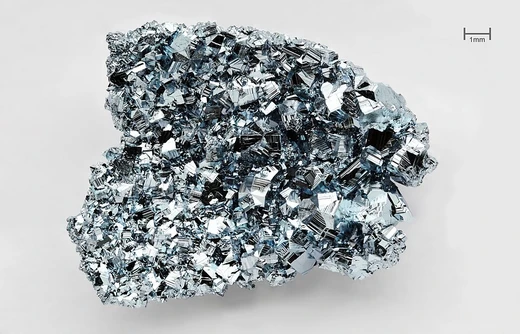
Platinum is a chemical element with the symbol Pt and atomic number 78. It is a dense, malleable, ductile, highly unreactive, precious, silverish-white transition metal. Its name originates from Spanish platina, a diminutive of plata 'silver'. Platinum is a member of the platinum group of elements and group 10 of the periodic table, and it has six naturally occurring isotopes. It is one of the rarer elements in Earth's crust, with an average abundance of approximately 5 μg/kg, and it occurs in some nickel and copper ores along with native deposits.
- symbol
- Pt
- atomic_number
- 78
- group
- 10
- period
- 6
- block
- d
- category
- transition metal
- natural_isotopes
- 6
Lore & Background
Platinum does not corrode, even at high temperatures, and is therefore considered a noble metal. Consequently, platinum is often found chemically uncombined as native platinum. Because it occurs naturally in the alluvial sands of various rivers, it was first used by pre-Columbian South American natives to produce artifacts.
Reader's Guide
Platinum is a key component in catalytic converters, laboratory equipment, electrical contacts and electrodes, platinum resistance thermometers, dentistry equipment, and jewelry. It is also used in the glass industry to manipulate molten glass, which does not 'wet' platinum. Compounds containing platinum, such as cisplatin, oxaliplatin and carboplatin, are applied in chemotherapy as treatment for certain types of cancer. Because of its scarcity in Earth's crust, barely a few hundred metric tonnes are produced annually, and given its critical and important uses, it is highly valuable as well as a major precious metal commodity.
Did You Know?
- Gold is the most ductile of pure metals, not platinum.
- The most abundant isotope of platinum is 195Pt, comprising 33.83% of all platinum.
- Platinum is insoluble in hydrochloric and nitric acid, but dissolves in hot aqua regia to form chloroplatinic acid.
- The radioactive isotope 190Pt undergoes alpha decay with a half-life of approximately 6.5×10^11 years.
Physical & Chemical Properties
Platinum is a lustrous, silver-white transition metal that stands out for its extraordinary ductility, exceeding even gold, silver, and copper among pure metals. It is dense, malleable, and highly resistant to corrosion, earning its classification as a noble metal. Its most common oxidation states are +2 and +4, with tetracoordinate platinum(II) compounds tending to adopt 16-electron square planar geometries. The metal resists hydrochloric and nitric acids individually but dissolves in hot aqua regia to yield chloroplatinic acid. As a soft acid, the Pt²⁺ ion exhibits a strong affinity for sulfide and sulfur ligands, a property that demands careful solvent selection in synthetic chemistry.
Rarity, Occurrence & Mining
Platinum is extraordinarily scarce in Earth's crust, occurring at a concentration of only about 5 micrograms per kilogram. This extreme rarity means barely a few hundred metric tonnes are produced globally each year, yet the metal's critical uses make it a highly valuable precious commodity. It is often found chemically uncombined as native platinum, particularly in alluvial river sands. Pre-Columbian South American natives in Colombia's Chocó Department worked these deposits into artifacts long before European contact. Major geological sources include the Ural Mountains in Russia and the Sudbury Basin in Ontario, Canada, where the arsenide mineral sperrylite (PtAs₂) serves as a key platinum-bearing phase in nickel ores. In nickel and copper deposits, platinum-group metals also occur as sulfides, tellurides, antimonides, and end alloys.
Industrial & Medical Applications
Platinum's chemical inertness and resistance to wear make it indispensable across a remarkable range of industries. Beyond catalysis, platinum appears in laboratory equipment, electrical contacts, electrodes, platinum resistance thermometers, and dentistry. In the glass industry, molten glass does not wet platinum, making the metal ideal for manipulating it. Its resistance to tarnish and wear suits fine jewelry perfectly. Perhaps most remarkably, platinum compounds such as cisplatin, oxaliplatin, and carboplatin serve as chemotherapy agents in the treatment of certain cancers, bridging the gap between inorganic chemistry and life-saving medicine. This versatility, spanning from automotive exhaust systems to oncology wards, underscores why such a scarce element commands such a premium price.
History & Scientific Recognition
Although pre-Columbian South American peoples crafted artifacts from platinum found in alluvial sands, European awareness of the metal remained limited to passing references in 16th-century writings. The element's name derives from the Spanish platina, a diminutive of plata (silver), reflecting its silvery-white appearance. In the modern era, platinum's scientific importance has grown considerably. The element's six naturally occurring isotopes, including the NMR-active ¹⁹⁵Pt with its non-zero nuclear spin, have provided valuable tools in spectroscopy and isotope geology. Together, these contributions cement platinum's dual role as both a practical industrial material and a subject of fundamental scientific inquiry.
Frequently Asked Questions
Who is Platinum?
Platinum is a dense, silvery-white transition metal occupying position 78 on the periodic table. It sits in group 10, period 6, and is a proud member of the platinum-group family.
What are Platinum's standout abilities?
Its most celebrated trait is extreme chemical inertness — it shrugs off nearly every acid and reagent without reacting. On top of that, it is dense, malleable, and ductile, so it can be drawn into fine wire or hammered into sheet without fracturing.
Where does Platinum appear in nature?
It is one of the scarcest elements in Earth's crust, averaging only about 5 micrograms per kilogram of rock. It is most often recovered from nickel and copper ores, though occasional native metal deposits do exist.
What role does Platinum play in the real world?
It serves as a premier catalyst in industrial chemistry and automotive exhaust systems, where it helps decompose toxic pollutants. Its luster and durability also make it a go-to metal for fine jewelry and luxury goods.
Why is Platinum considered so precious?
Its natural scarcity on Earth, six stable isotopes, and near-total resistance to corrosion make it far harder to obtain than common base metals. That combination of rarity and versatility in catalysis and ornamentation keeps its market value consistently high.
More in Chemical Elements & Metals 1-20
Spotted an error? Know more?
This is a living reference — every entry is fact-audited, and reader corrections feed straight into our audit queue. Suggest an edit · See this site's audit record