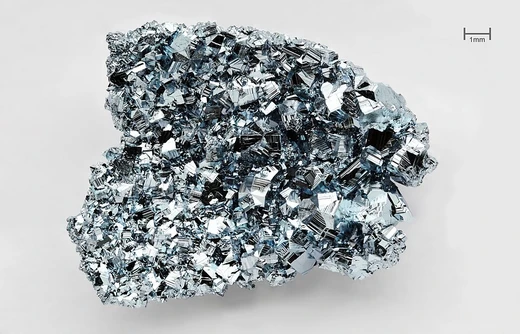
Radium
Radioactive alkaline earth metal discovered by the Curies.

Radium is a chemical element with symbol Ra and atomic number 88, the sixth element in group 2 of the periodic table (alkaline earth metals). It is a silvery-white metal that readily reacts with nitrogen upon exposure to air, forming a black surface layer of radium nitride. Due to its radioluminescence, it was widely used in self-luminous paints, but its radioactivity makes it particularly toxic and carcinogenic, especially because it accumulates in bones and produces radon gas.
- symbol
- Ra
- atomic_number
- 88
- group
- alkaline earth metals
- discoverers
- Marie and Pierre Curie
- key_property
- radioactive, radioluminescent
Lore & Background
They extracted the radium compound from uraninite and published the discovery at the French Academy of Sciences five days later. Soon afterwards, the metal started being produced on larger scales in Austria, the United States, and Belgium.
Reader's Guide
Radium's significance lies in its historical and scientific impact as a radioactive element that enabled early studies of radioactivity and found widespread use in self-luminous paints from the 1910s to the 1970s. Its radioluminescence made it valuable for watch dials and instrument panels, but its toxicity and carcinogenicity—due to its radioactivity, its decay product radon, and its tendency to accumulate in bones—led to its replacement by less dangerous radioisotopes. In nature, radium is found in uranium ores in tiny quantities, and it is not necessary for living organisms. Its legacy includes both scientific advancement and a cautionary tale about the dangers of radioactive materials.
Did You Know?
- Pure radium is silvery-white but turns black upon exposure to air due to formation of radium nitride.
- Radium was used in radioactive quackery for its supposed curative power from the 1910s to the 1970s.
- Radium's immediate decay product is the radioactive noble gas radon, which is responsible for much of the danger of environmental radium.
Discovery and the Path to Isolation
Working with the compound radium chloride, they separated it from the mineral matrix and announced their findings at the French Academy of Sciences just five days after completing the extraction. The element, which they named radium, carried the symbol Ra and atomic number 88, placing it as the sixth member of the alkaline earth metal family. Shortly after that breakthrough, small-scale industrial production began in Austria, the United States, and Belgium. Yet the quantities involved have always been vanishingly small relative to other elements. By the 2010s, the entire world was producing fewer than one hundred grams of radium per year, most of it recovered as a by-product from spent nuclear fuel rather than mined from ore.
Physical and Chemical Character
Radium holds the distinction of being the heaviest alkaline earth metal and the sole radioactive member of group 2. In its pure form it appears as a lustrous, volatile silvery-white metal, a shade more brilliant than its lighter relatives calcium, strontium, and barium, which carry a faint yellow tint. However, that gleaming surface is short-lived; contact with air quickly produces a dark coating of radium nitride, Ra3N2, because the metal preferentially bonds with nitrogen rather than oxygen. At standard conditions radium adopts a body-centered cubic crystal lattice with a radium-to-radium bond distance of 514.8 picometers, and its density of 5.5 g/cm³ exceeds that of barium. Chemically, radium is unremarkable in one sense: it shows only the +2 oxidation state, forming a colorless, highly basic Ra²⁺ cation that resists complex formation. Most of its compounds are straightforward ionic salts, though relativistic effects involving the 6s and 6p electrons lend a modest degree of covalent character to species such as RaF₂ and RaAt₂.
Radioactivity and the Threat to Living Tissue
That isotope, which constitutes nearly all naturally occurring radium, is roughly 2.7 million times more radioactive per mole than natural uranium. A sample of radium metal even warms itself above ambient temperature because of the energy released by its own decay. The primary emissions are alpha particles, but the broader decay chain that follows produces beta particles and gamma rays as well. From a biological standpoint, radium is especially dangerous. Because it sits in the same group as calcium, the body treats it as a nutritional mineral and deposits it in bone tissue, where the sustained ionizing radiation damages cells and promotes cancer. Radium is not required by any living organism, and its chemical mimicry of calcium makes accidental incorporation into biochemical pathways a recipe for severe harm.
From Luminous Dials to a Medical Niche
The ability of radium's radiation to excite fluorescent chemicals and produce a steady glow made it the star ingredient in self-luminous paints from the 1910s through the 1970s, coating watch faces, instrument panels, and emergency signage. The element also found a place in the world of radioactive quackery, marketed as a curative tonic despite the absence of any legitimate medical basis. In nature, radium is extraordinarily scarce: uranium ores contain roughly one-seventh of a gram per ton of uraninite, and thorium ores hold only trace quantities. As the dangers of chronic radiation exposure became undeniable, nearly every commercial and consumer use of radium was phased out in favor of safer radioisotopes. One narrow non-medical use persists: radium is fed into nuclear reactors to breed actinium, a by-product of its decay. The global annual output, now drawn mainly from spent nuclear fuel, remains under one hundred grams, a testament to how thoroughly the world has moved beyond the glow of radium.
Frequently Asked Questions
Who is Radium?
Radium is a silvery-white alkaline earth metal with the symbol Ra and atomic number 88, placing it as the sixth member of group 2 on the periodic table. It is best known for being intensely radioactive and for glowing on its own in the dark.
What are Radium's signature abilities or key properties?
Radium's defining trait is its radioluminescence—it produces a steady, self-sustained glow without any external energy source. This natural luminescence, paired with its powerful radioactivity, made it both a scientific marvel and a serious health hazard.
Who discovered Radium?
Marie and Pierre Curie isolated Radium in the late 1890s by painstakingly processing tons of pitchblende ore. Their breakthrough work on this and other radioactive elements earned them a Nobel Prize and reshaped modern physics and chemistry.
Why is Radium so dangerous to living tissue?
Because Radium chemically mimics calcium, the body absorbs it and deposits it in bone, where it continuously irradiates surrounding cells and dramatically raises cancer risk. It also releases radon gas as a decay product, compounding the toxic exposure.
What was Radium's most famous real-world role?
Before its dangers were fully recognized, Radium was mixed into self-luminous paints used on watch dials, instrument panels, and emergency signage. The tragic health stories of workers such as the Radium Girls later exposed how severely that practice could damage the human body.
More in Chemical Elements & Metals 1-20
Spotted an error? Know more?
This is a living reference — every entry is fact-audited, and reader corrections feed straight into our audit queue. Suggest an edit · See this site's audit record