Selenium
Essential trace element and semiconductor discovered in 1817.

Selenium is a chemical element with symbol Se and atomic number 34. It was discovered in 1817 by Jöns Jacob Berzelius, who noted its similarity to tellurium. Selenium is essential in trace amounts for many animals, including humans, but is toxic in higher doses.
- symbol
- Se
- atomic_number
- 34
- discovered_by
- Jöns Jacob Berzelius
- year_discovered
- 1817
- category
- nonmetal (more rarely considered a metalloid)
- common_allotropes
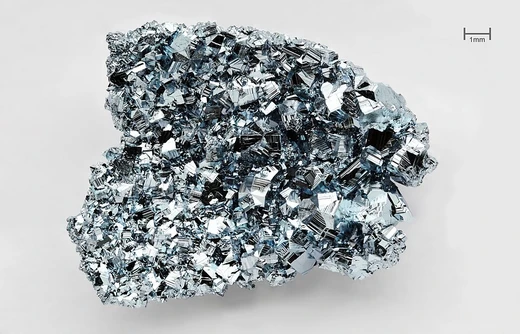
- brick-red powder, vitreous black solid, grey metallic-looking form
Lore & Background
Selenium seldom occurs in its elemental state or as pure ore compounds in Earth's crust. It is found in metal sulfide ores, where it substitutes for sulfur, and is produced commercially as a byproduct in ore refining. The element's name derives from the Greek word for 'moon', reflecting its similarity to tellurium, named for the Earth. Selenium forms several allotropes that interconvert with temperature changes. The most stable form is gray selenium, a semiconductor with a chiral hexagonal crystal lattice. Other allotropes include amorphous brick-red powder and vitreous black solid. Selenium is used in glassmaking, pigments, photocells, DC power surge protectors, and fluorescent quantum dots. Selenium is a component of antioxidant enzymes such as glutathione peroxidase and thioredoxin reductase, and is listed as an ingredient in multivitamins, dietary supplements, and infant formula. However, both elemental selenium and its salts are toxic in even small doses, causing selenosis with symptoms including diarrhea, fatigue, hair loss, and joint pain.
Reader's Guide
Selenium occupies a unique position as both an essential nutrient and a toxic substance. Its role in antioxidant enzymes underscores its biological importance, while its semiconductor properties made it valuable in early electronics, though largely replaced by silicon. The element's allotropes exhibit diverse physical properties, from insulating red powder to photoconductive gray metal. Commercially, selenium remains important in glassmaking and pigments, and finds niche applications in surge protectors and quantum dots. Its discovery by Berzelius in 1817 added a new element to the periodic table, bridging sulfur and tellurium. The dual nature of selenium—necessary for life yet dangerous in excess—illustrates the delicate balance of trace elements in biology. Its presence in infant formula and multivitamins reflects careful regulation to provide benefit without harm.
Did You Know?
- Selenium was discovered in 1817 by Jöns Jacob Berzelius, who named it after the Greek word for 'moon'.
- Gray selenium is a semiconductor and shows appreciable photoconductivity, unlike other selenium allotropes.
- Selenium is a component of the antioxidant enzymes glutathione peroxidase and thioredoxin reductase.
- Selenium disulfide, with an approximate composition of SeS2, has been used in shampoo as an anti-dandruff agent.
Frequently Asked Questions
Who is Selenium?
Selenium is element 34 on the periodic table, a nonmetal (occasionally grouped as a metalloid) with the symbol Se. It belongs to group 16, sharing a chemical family with oxygen and sulfur.
What are Selenium's powers and role?
Selenium serves as a semiconductor in electronics and appears in several distinct allotropes, including a brick-red powder, a glassy black solid, and a grey metallic-looking form. In biology it acts as a critical trace nutrient for humans and many animals.
How was Selenium discovered?
Swedish chemist Jöns Jacob Berzelius identified selenium in 1817 after observing its close resemblance to tellurium. He named it from the Greek word for moon, pairing it with tellurium's Earth-based name.
Why is Selenium important?
In small trace amounts, selenium is essential for proper thyroid function and antioxidant defense in humans and other animals. However, exceeding the safe range makes it toxic, so the balance between benefit and harm is narrow.
What does Selenium look like in different forms?
Selenium can present as a brick-red powder, a vitreous black solid, or a grey form with a metallic sheen. These allotropes give it a surprisingly varied visual identity compared to most elements on the table.
More in Chemical Elements & Metals 1-20
Spotted an error? Know more?
This is a living reference — every entry is fact-audited, and reader corrections feed straight into our audit queue. Suggest an edit · See this site's audit record