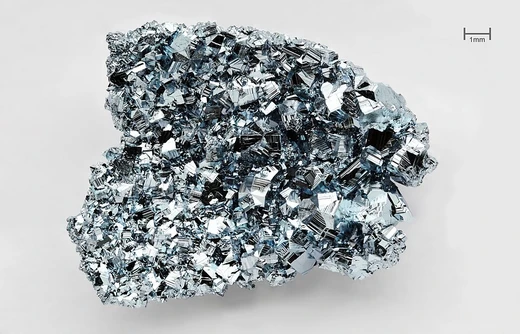
Scandium
A rare-earth element used primarily in aluminium alloys.

Scandium is a chemical element with symbol Sc and atomic number 21. It is a silvery-white metallic element found in the d-block of the periodic table, usually classified as a rare-earth element together with yttrium and the lanthanides. Its use in aluminium alloys, discovered in the 1970s, remains its only major application.
- symbol
- Sc
- atomic_number
- 21
- discoverers
- Lars Fredrik Nilson and his team
- classification
- Rare-earth element
- major_application
- Aluminium alloys
Lore & Background
Nilson named the element scandium from the Latin Scandia meaning 'Scandinavia'. Per Teodor Cleve recognized the correspondence with Mendeleev's prediction and notified him. Scandium is a soft metal with a silvery appearance, developing a slightly yellowish or pinkish cast when oxidized by air. It dissolves slowly in most dilute acids but does not dissolve in a 1:1 mixture of nitric acid and 48.0% hydrofluoric acid, possibly due to an impermeable passive layer. Scandium turnings ignite in air with a brilliant yellow flame to form scandium oxide.
Reader's Guide
Scandium's significance lies in its unique properties and limited but impactful applications. Although not rare in Earth's crust (18–25 ppm, comparable to cobalt), it is distributed sparsely and occurs in trace amounts in many minerals. The global trade of scandium oxide is 15–20 tonnes per year, with demand slightly higher and both production and demand increasing. Its primary application is in strengthening aluminium alloys with as little as 0.5% scandium, a discovery made in the 1970s. Scandium-stabilized zirconia also enjoys growing market demand as a high-efficiency electrolyte in solid oxide fuel cells. The absence of reliable, secure, long-term production has limited commercial applications, but efforts to increase production include facilities in the Philippines and a planned primary scandium operation in New South Wales. Scandium chemistry is dominated by the trivalent ion Sc3+, with properties intermediate between aluminium and yttrium, and a diagonal relationship exists between magnesium and scandium.
Did You Know?
- The global trade of scandium oxide is 15–20 tonnes per year.
- Scandium is found exclusively in nature as the isotope 45Sc, which has a nuclear spin of 7/2.
Frequently Asked Questions
Who is Scandium?
Scandium is a silvery-white metallic element carrying the symbol Sc and atomic number 21, positioned in the d-block of the periodic table. It is most commonly grouped with yttrium and the lanthanides under the rare-earth element label.
What are Scandium's powers or role?
Scandium's signature strength lies in reinforcing aluminium alloys, where it dramatically improves the strength-to-weight ratio of the resulting metal. Outside that niche, it has very few other notable industrial roles.
How does Scandium's story end?
Scandium's major plotline revolves around its adoption in aluminium alloys, a breakthrough that gained real traction during the 1970s. That single application still stands as its only significant commercial use to this day.
Why is Scandium important?
Even though it is a rare-earth element found in relatively small quantities, Scandium earns its place by making aluminium alloys lighter and tougher. It also holds a structural spot as the first element in the third row of the d-block.
Who discovered Scandium?
Scandium was identified by Lars Fredrik Nilson and his research team in the late 19th century. Their work filled a gap that had been predicted in the periodic table, confirming the element's expected position at atomic number 21.
More in Chemical Elements & Metals 1-20
Spotted an error? Know more?
This is a living reference — every entry is fact-audited, and reader corrections feed straight into our audit queue. Suggest an edit · See this site's audit record