Samarium
A lanthanide metal used in magnets, medicine, and nuclear reactors.

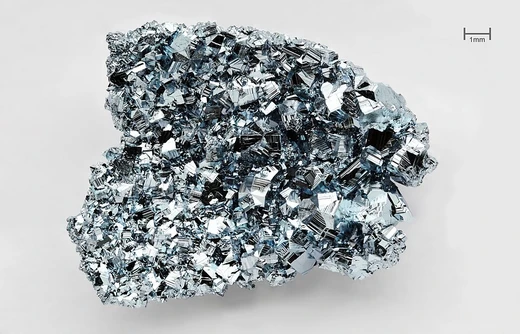
Samarium is a chemical element with the symbol Sm and atomic number 62. It is a moderately hard silvery metal that slowly oxidizes in air and is a typical member of the lanthanide series, usually exhibiting the oxidation state +3.
- symbol
- Sm
- atomic_number
- 62
- discovered_by
- Paul-Émile Lecoq de Boisbaudran
- series
- Lanthanide
- common_oxidation_state
- +3
Lore & Background
The mineral had been named after Vassili Samarsky-Bykhovets, a Russian mine official, marking the first indirect naming of an element after a person. Samarium occurs in concentrations up to 2.8% in minerals such as cerite, gadolinite, samarskite, monazite, and bastnäsite, with the last two being the most common commercial sources. These minerals are primarily found in China, the United States, Brazil, India, Sri Lanka, and Australia, with China leading in mining and production. Samarium has several notable physical properties. It has a hardness and density similar to zinc, and it is the third most volatile lanthanide after ytterbium and europium. Samarium exhibits multiple crystal structures depending on temperature and pressure, including rhombohedral, hexagonal close-packed, body-centered cubic, and double-hexagonally close-packed phases. The metal and its sesquioxide are paramagnetic at room temperature, and the metal becomes antiferromagnetic at 14.8 K. Samarium atoms can be encapsulated in fullerene molecules or intercalated into C60 to form a superconductor at 8 K. Chemically, samarium slowly oxidizes in air and spontaneously ignites at 150 °C. It reacts with cold water slowly and with hot water rapidly to form samarium hydroxide, and it dissolves in dilute sulfuric acid to produce Sm(III) ions. Samarium is one of the few lanthanides with a relatively accessible +2 oxidation state, alongside europium and ytterbium, and its Sm2+ ions are blood-red in aqueous solution. The element forms various compounds, including oxides, chalcogenides, halides, and borides, with samarium(II) iodide being a common reducing agent in chemical synthesis.
Reader's Guide
Samarium holds significance across multiple fields. Additional uses include catalysis of chemical reactions, radioactive dating, and X-ray lasers. Samarium(II) iodide is a common reducing agent in chemical synthesis. Samarium has no biological role, and some of its salts are slightly toxic. The element's unique phase transitions and magnetic properties also contribute to research in materials science and superconductivity, with samarium doping of iron-based superconductors raising their transition temperature to 56 K, the highest achieved in that series.
Did You Know?
- Samarium was the first chemical element indirectly named after a person, Russian mine official Vassili Samarsky-Bykhovets.
- Samarium(II) iodide is a common reducing agent in chemical synthesis.
Frequently Asked Questions
Who is Samarium?
Samarium is the 62nd element on the periodic table, a silvery lanthanide metal first identified by French chemist Paul-Émile Lecoq de Boisbaudran. It carries the symbol Sm and sits squarely in the middle of the rare-earth family.
What are Samarium's powers/role?
In practical applications, Samarium powers high-strength permanent magnets, supports targeted cancer treatments in medicine, and serves in neutron-absorbing control rods inside nuclear reactors. In nearly every compound it forms, it locks into the +3 oxidation state.
How does Samarium's story end?
Left exposed to open air, Samarium's silvery surface gradually dulls as it slowly oxidizes rather than igniting or flaking off dramatically. Its 'ending' is a quiet, steady loss of metallic luster over time.
Why is Samarium important?
Samarium is a critical ingredient in the high-temperature permanent magnets found in wind turbines, electric-vehicle motors, and precision instruments. It also plays a niche but vital role in radiotherapy and in keeping nuclear reactor chains under control.
What is Samarium's signature trait?
Its defining hallmark is a moderately hard, silvery appearance combined with a near-exclusive preference for the +3 valence state in all of its chemistry. That consistent bonding behavior is the 'house rule' behind every compound and application it is known for.
More in Chemical Elements & Metals 1-20
Spotted an error? Know more?
This is a living reference — every entry is fact-audited, and reader corrections feed straight into our audit queue. Suggest an edit · See this site's audit record