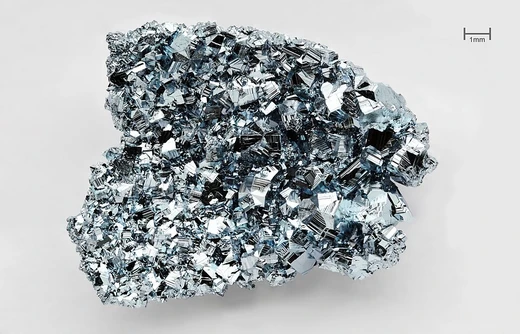
Ruthenium

Ruthenium is a chemical element with symbol Ru and atomic number 44. It is a rare transition metal belonging to the platinum group, known for its unreactive nature and use in wear-resistant electrical contacts and thick-film resistors.
- symbol
- Ru
- atomic_number
- 44
- discovered_by
- Karl Ernst Claus
- group
- platinum group, group 8
- notable_property
- unreactive to most chemicals
Lore & Background
Ruthenium is a polyvalent hard white metal that does not tarnish at ambient conditions but oxidizes upon heating to 800 °C. It is not attacked by acids, including aqua regia, but is attacked by sodium hypochlorite and halogens at high temperatures. Ruthenium has four crystal modifications and is the only 4d transition metal that can assume the +8 oxidation state, though it is less stable than osmium in that state. Naturally occurring ruthenium consists of seven stable isotopes, and 34 synthetic radioactive isotopes have been discovered, with 106Ru being a fission product of uranium or plutonium.
Reader's Guide
Its primary applications include wear-resistant electrical contacts and thick-film resistors, with newer uses in extreme-ultraviolet photomasks for semiconductor lithography. Small amounts of ruthenium increase the hardness of platinum and palladium and markedly improve the corrosion resistance of titanium. The element is obtained commercially as a by-product from processing nickel, copper, and platinum ores, with major deposits in the Ural Mountains, North and South America, Sudbury (Ontario), and South Africa. Its presence in spent nuclear fuel and potential for production via nuclear transmutation from technetium-99 highlight its relevance in both industrial and nuclear contexts.
Did You Know?
- Ruthenium is the only 4d transition metal that can assume the +8 oxidation state.
- Ruthenium is generally found in ores with other platinum-group metals in the Ural Mountains and in North and South America.
- 106Ru, a radioactive isotope of ruthenium, is a fission product of uranium or plutonium.
Frequently Asked Questions
Who is Ruthenium?
Ruthenium (Ru) is a rare transition metal with atomic number 44, sitting in group 8 of the periodic table. It belongs to the platinum group of elements and is one of the least abundant naturally occurring metals on Earth.
What are Ruthenium's powers and role?
Its signature trait is extreme chemical inertness—most common reagents simply cannot touch it. In practical terms, that makes it ideal for wear-resistant electrical contacts and thick-film resistors in electronics, where it must survive repeated mechanical stress without degrading.
How was Ruthenium discovered?
The element was identified in 1844 by the Baltic-German chemist Karl Ernst Claus, who isolated it from platinum-group ores in the Ural Mountains region. His work confirmed that the material was a distinct element rather than an impurity of other platinum-group metals.
Why is Ruthenium important to the metals community?
Because it is so scarce, any sample carries significant value, and its combination of hardness, corrosion resistance, and electrical stability fills a niche that no other platinum-group member covers as well. Engineers in the electronics and catalysis industries rely on it for components that must last under harsh conditions.
Where does Ruthenium sit relative to its platinum-group family?
It occupies group 8, flanked by iron, osmium, and hassium in its column, and sits between technetium and rhodium in period five. Within the platinum group it is the lightest member, giving it a slightly different set of oxidation states and metallic properties compared to heavier relatives like iridium or platinum.
More in Chemical Elements & Metals 1-20
Spotted an error? Know more?
This is a living reference — every entry is fact-audited, and reader corrections feed straight into our audit queue. Suggest an edit · See this site's audit record