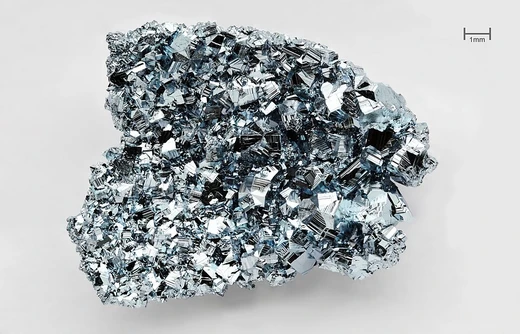
Rubidium

Rubidium is a chemical element with symbol Rb and atomic number 37. The name comes from the Latin word rubidus, meaning deep red, the color of its emission spectrum.
- symbol
- Rb
- atomic_number
- 37
- discovered_by
- Robert Bunsen and Gustav Kirchhoff
- group
- alkali metal
- melting_point
- 39.3 °C
Lore & Background
Because of the bright red lines in its emission spectrum, they chose a name derived from the Latin word rubidus, meaning 'deep red'. Kirchhoff and Bunsen processed 150 kg of lepidolite containing only 0.24% rubidium monoxide, eventually obtaining 0.51 grams of rubidium chloride for further studies.
Reader's Guide
Rubidium is significant as the first alkali metal with a density higher than water and as a key element in laser manipulation of atoms due to its convenient spectral absorption range. Its compounds have various chemical and electronic applications, including rubidium chloride used to induce living cells to take up DNA and as a biomarker. Rubidium-87, with a half-life of 48.8 billion years, is used extensively in dating rocks via the rubidium–strontium dating method. Although not abundant, it is more abundant in Earth's crust than zinc or copper, and its production is limited to 2 to 4 tonnes per year due to limited applications and lack of a mineral rich in rubidium.
Did You Know?
- Rubidium is the first alkali metal in the group to have a density higher than water.
- Natural rubidium comprises two isotopes: 72% stable 85Rb and 28% slightly radioactive 87Rb with a half-life of 48.8 billion years.
- Rubidium reacts explosively with water, producing rubidium hydroxide and hydrogen gas.
- Rubidium was the second element discovered by spectroscopy, shortly after caesium.
Frequently Asked Questions
Who is Rubidium?
Rubidium (Rb, atomic number 37) is a soft, silvery-white alkali metal sitting in Group 1 of the periodic table. It sits just below potassium and above cesium, making it part of the famously reactive 'first column' family.
What are Rubidium's powers or role?
As an alkali metal, Rubidium reacts explosively with water and ignites on its own in moist air, so it must be stored under oil. Its melting point is a mere 39.3 °C, meaning it can soften in a warm hand—far lower than most metals.
How does Rubidium's story end?
Rubidium is so reactive that it essentially 'ends' in a violent flash the moment it meets water or oxygen, producing rubidium hydroxide or oxide. In nature it never appears as a free metal; you only find it locked inside minerals like leucite or pollucite.
Why is Rubidium important to the wider element community?
Rubidium atoms are the working heart of precision atomic clocks and rubidium-vapor laser cells used in GPS satellites and spectroscopy labs. Its single outer electron makes it a go-to tool for studying quantum behavior and ultra-precise timekeeping.
What is Rubidium's origin story?
Robert Bunsen and Gustav Kirchhoff spotted Rubidium in 1861 by running mineral samples through a flame and reading the deep-red lines in the emission spectrum. They named it from the Latin 'rubidus,' meaning deep red, after that signature crimson glow.
More in Chemical Elements & Metals 1-20
Spotted an error? Know more?
This is a living reference — every entry is fact-audited, and reader corrections feed straight into our audit queue. Suggest an edit · See this site's audit record